01
Reader
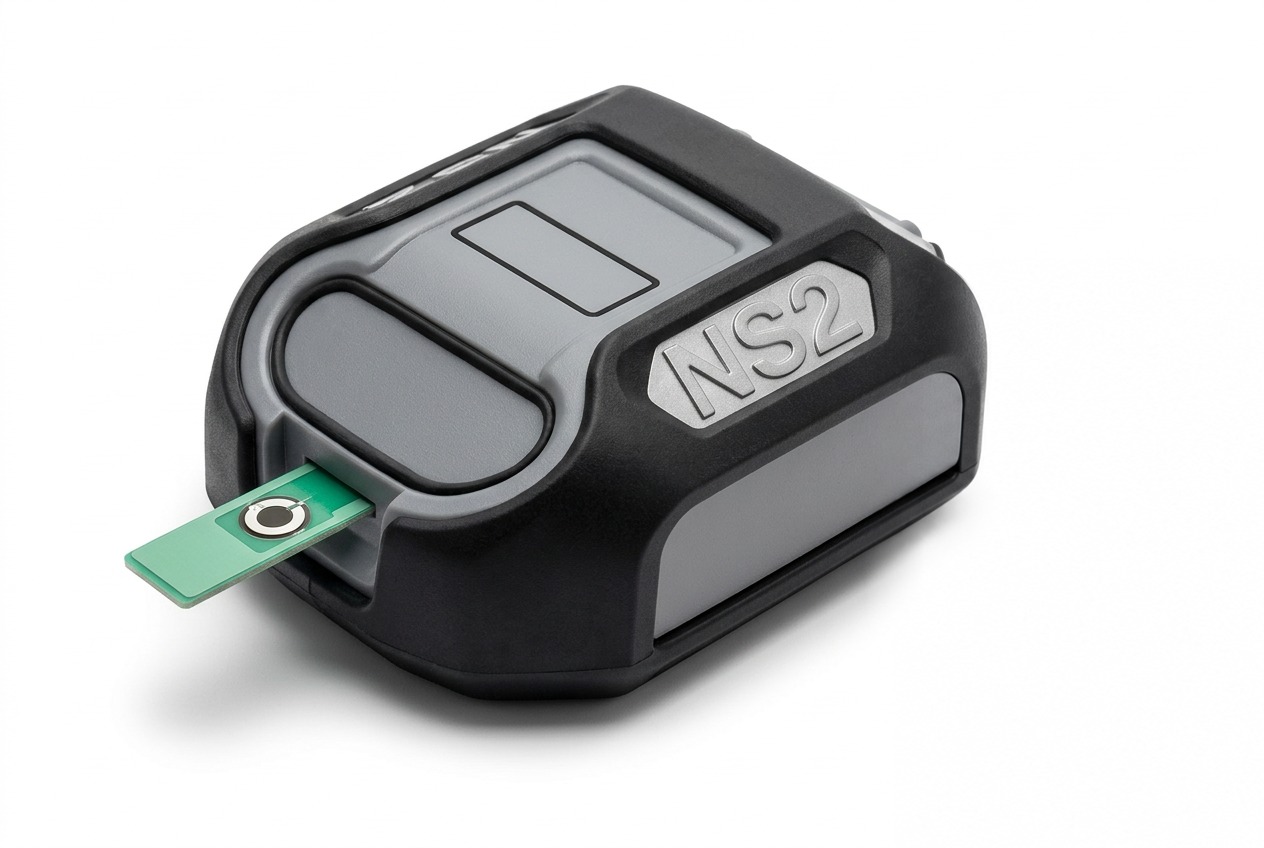
A compact handheld electrochemical reader.
- Pocket-sized and rugged
- Reads every NS2 strip
- Pairs with the app
- Electrochemical measurement, lab-grade results
- Battery-powered for use in the field

Technology
Electrochemical sensing brings lab-grade precision to a handheld format.
01
A compact handheld electrochemical reader.

02
Single-use sensing strips, one per analyte. One drop is enough.
03
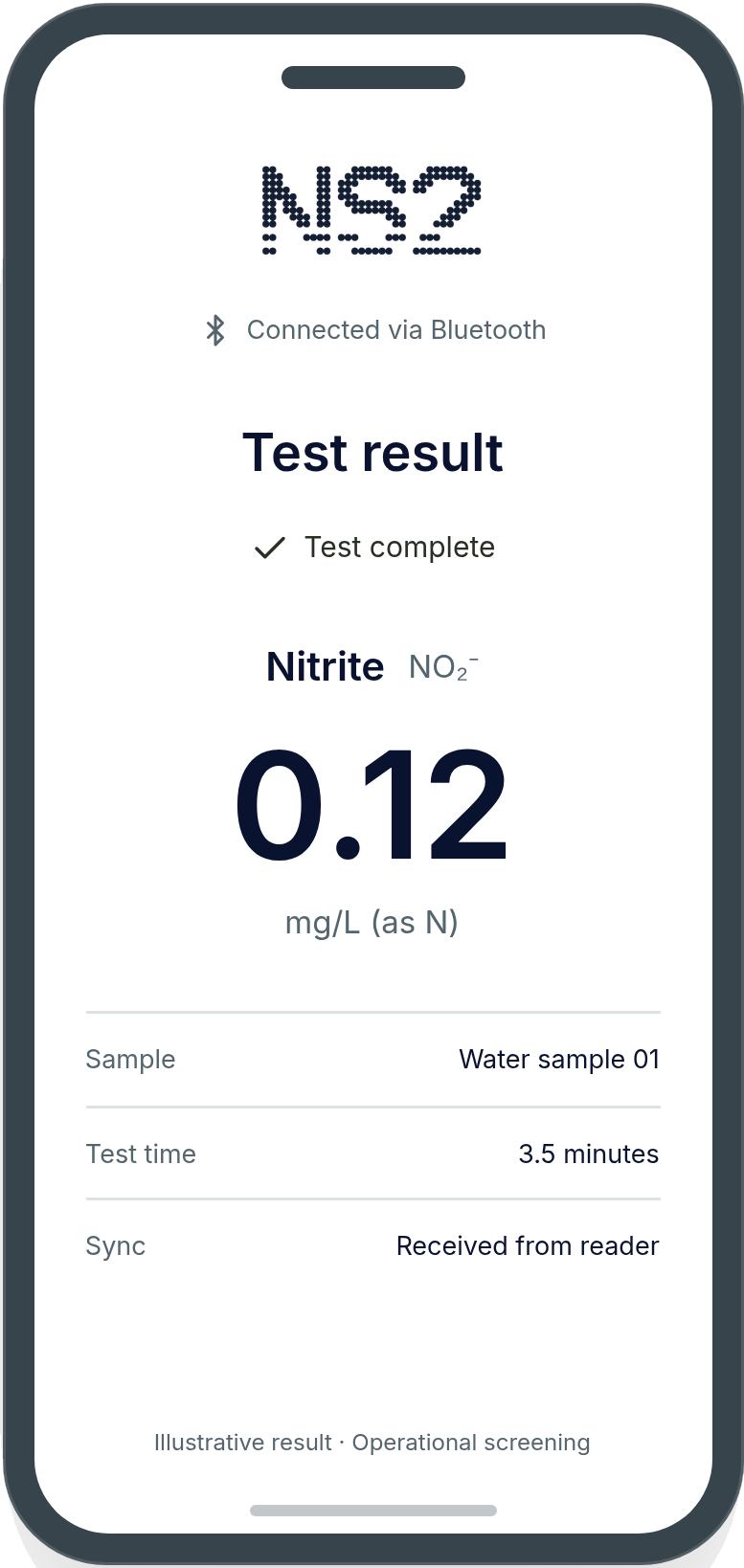
Results, history and export on your phone.
01 · The reader
The reader is the other half of the test. The cartridge slides into one end; the reader powers it, reads the current it produces and sends a clear number to your phone over Bluetooth. There is no screen to learn — your phone is the display. No bench, no reagents, no calibration step.
02 · The cartridges
Each cartridge is a single-use electrochemical sensor strip, sealed in a foil pouch and pre-calibrated for the reader. Open, insert, add one drop.
03 · The app
The NS2 app pairs with the reader to capture each result with time and location, sync it to your account, and share data through an open API. Available for iOS and Android.
The science behind the sensor
An enzyme layer reacts only with nitrite, even in salty or murky water.
European patent granted · US patent pending.
We measure an electric current, not a color, so cloudy water doesn't distort results.
Each strip carries its own calibration (QR code). No standards, no setup.
Enzyme-based methods already have regulatory standing.
Labs, sensors and NS2: three roles
NS2 works alongside certified labs and online sensors, not against them. Most well-run water systems need all three.
The certified record
Best for: Compliance reporting, baselines, full nutrient panels.
Limits: Results take days, and budgets allow few samples.
The fast, specific answer
Best for: Daily checks, the gaps between lab samples, checking sensors, choosing which samples to send to the lab.
Limits: Spot tests, not continuous.
The continuous trend
Best for: 24/7 alarms and process control at fixed points.
Limits: Costly per site; drift and fouling need regular checks.
Validated against the gold standard
In pilots with fish farms in Norway and Portugal, NS2 nitrite readings agreed with the Griess method, the laboratory reference, across trout, salmon smolt, carp, tilapia and shrimp systems.
The science behind it
"An efficient non-mediated amperometric biosensor for nitrite determination" — Biosensors and Bioelectronics, 2010
Read the research summary
"Synthesis of WO₃ nanoparticles for biosensing applications" — Sensors and Actuators B: Chemical, 2016
Read the research summary
"Construction of effective disposable biosensors for point of care testing of nitrite" — Talanta, 2015
Read the research summary
"Biosensing nitrite using the system nitrite reductase/Nafion/methyl viologen — A voltammetric study" — Biosensors and Bioelectronics, 2007
Read the research summary
"A quasi-reagentless point-of-care test for nitrite and unaffected by oxygen and cyanide" — Scientific Reports, 2019
Read the research summary
Availability
Contact us for pricing and delivery.
| Analyte | Freshwater | Marine |
|---|---|---|
| Nitrite | Available now | Available now |
| Nitrate | 2027 | 2027 |
| Ammonium | Available now | 2028 |
Because the reading is an electric current and not a colour, cloudy or coloured samples do not shift the result.
An enzyme layer reacts with the target compound — with nitrite on the nitrite strip — so other ions in the sample stay out of the reading.
A European patent is granted and a US patent is pending.
It powers the cartridge, measures the current the strip produces and sends the number to your phone over Bluetooth. The phone is the display.
The methods build on more than 25 years of published, peer-reviewed research, and the enzyme approach already has regulatory standing.